
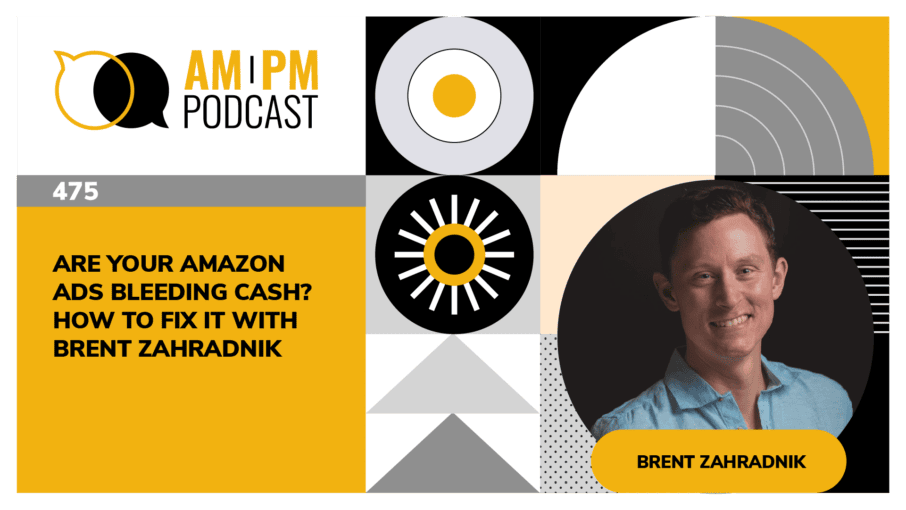
#475 – Are Your Amazon Ads Bleeding Cash? How to Fix It with Brent Zahradnik
Can you afford to miss out on the secrets behind optimizing Amazon PPC, AMC, and DSP? Brent Zahradnik, a seasoned expert in Amazon advertising, brings his wealth of experience to our show, uncovering the complexities of Amazon advertising. Brent’s journey from the US to France adds a unique perspective to the conversation as he shares how balancing work across time zones and immersing in French culture has enriched his professional insights.
Amazon advertising has evolved dramatically from its early days of low cost-per-click rates and basic ad options. This episode unpacks the intricate landscape that demands expert management today, highlighting how advanced targeting and analytics have transformed strategy requirements. Brent shares poignant anecdotes of Amazon’s initial ad experiments, while navigating the challenges that both advertisers and clients face in maintaining a competitive edge in this pay-to-play ecosystem.
The potential impact of AI on Amazon advertising agencies is another compelling topic Brent tackles, discussing how tools like Amazon Marketing Cloud (AMC) and Demand Side Platform (DSP) can revolutionize efficiency. With insights into selecting the right agency and the importance of comprehensive service packages, Brent guides listeners through optimizing their Amazon ad strategy. Whether you’re a brand new to the platform or a seasoned seller, this episode promises actionable insights and the guidance needed to thrive in today’s Amazon marketplace.
In episode 47 of the AM/PM Podcast, Kevin and Brent discuss:
- 00:00 – Exploring Amazon PPC With Brent Zahradnik
- 06:39 – Rise of Amazon Advertising Complexity
- 09:53 – Evolution of Amazon Advertising
- 12:44 – Agency vs Software in Amazon Sales
- 16:25 – AI in Amazon Advertising and Integration
- 23:00 – Impact of Rufus and COSMO in Amazon Advertising
- 26:08 – Amazon PPC Strategy and Data Analysis
- 30:55 – Keyword Strategy for Amazon Ranking
- 32:00 – Amazon DSP and Advertising Efficiency
- 35:07 – Modern Brand Building With Amazon DSP
- 38:16 – Combining Data Sets for Targeted Ads
- 41:26 – Customer Funnel Strategy for Conquesting
- 42:54 – Optimizing Amazon PPC and DSP Investments
- 47:59 – How Brands Can Utilize Amazon DSP
- 49:55 – Selecting an Amazon Advertising Agency
- 56:19 – Automated Conversion Campaigns in DSP
- 58:21 – Human Touch in Modern Advertising
Transcript
Kevin King:
Happy Thanksgiving and welcome to episode 475 of the AM/PM podcast. This week I’ve got Brent Zahradnik on. Brent is one of the top guys when it comes to PPC. He’s been doing it about 10 plus years on Amazon and we’re going to talk everything DSP, AMZ marketing, Cloud, where you’re wasting money, where you should be spending money, how to analyze reports the whole nine yards. So, it’s going to be a great episode. I think you’re going to really like this episode with Brent. Happy Thanksgiving everybody and welcome to the AM/PM podcast. Today We’ve got an amazing guest by way of France, but coming to you from Pennsylvania. Yeah, the Thanksgiving stuff actually I think a lot of it went down in that general area back in the day, right.
Brent:
I don’t know if we can claim to have invented it here, but yeah, it definitely happens.
Kevin King:
Yeah, we’ve got Brent Zahradnik on the podcast today. Brent is an old school, been around in the Amazon space for a while and one of the top minds when it comes to PPC, and I’m sure we’ll be getting into all that. But, Brent, welcome man, glad to have you here.
Brent:
Hey Kevin, thanks for the invite, much appreciated. And, yeah, happy to be recording in almost the same time zone as you this time instead of a good six to seven-hour difference.
Kevin King:
Exactly. How is, I mean I deal with a quite of few people that are in Europe or Asia or something. I got people that come to my webinar that’s in Australia and get up like 4am in the morning just to get on the webinar. You’re in France so your what, I’m in Texas, so that’s I think it’s seven-hour difference East Coast. Seven-hours from-
Brent:
Yeah, it’s a seven-hour difference six from the East and actually, generally speaking, I think it’s actually an advantage. So over the years I’ve had a lot of team members in Asia and in Europe. So that’s fairly easy because ahead of me or they’re in my same time and a lot of clients they’re not going to email you at eight in the morning. You’re going to get those emails in the afternoon, and so my mornings are like the deep work and then the afternoon is the calls. So it’s quite easy. I’ve worked with that kind of system for many years let’s call it, and if you want to talk to someone in North America, it’s pretty easy. If you want to talk to someone in Asia, it’s pretty easy. Europe’s kind of between the two. So in that way it’s actually really convenient.
Kevin King:
Actually, that is true. So what led you to France from the US?
Brent:
Well, when I started Pathfinder and the business started making like actual money, I started hiring people. I was able to travel a lot. First thing I did is I traveled around Asia a bunch and you know I’ve met you over the years at how many conferences and events in Europe uh, maybe one or two in Asia even. Uh, and that was always like really appealing. But eventually it was because of a relationship. I actually met a woman who’s French and now she’s my wife and I’ve lived there for eight years.
Kevin King:
So yeah, which part of France are you?
Brent:
I’ve lived in a couple of different places. I lived in Paris for a year and a half. I lived in a town called La Rochelle on the West Coast for half a year. We lived in Montpellier down south for five years and more recently we’ve moved to a town near Lyon in Eastern France called Villefranche-sur-Saône, which is in the wine region Beaujolais. If any of the listeners are into French wines, I’m still a debutante at this myself, but I’m learning slowly.
Kevin King:
Did you speak French before you move there?
Brent:
No, not at all, not at all.
Kevin King:
Are you fluent now, or are you just kind of hack your way through it?
Brent:
I’m like B1 level on the scale there’s like a Delft language scale. So there’s like A through C and there’s like A1, A2, B1, B2. I’m like B1, but I have to pass and get better to get to B2 in order to get like a long-term residency or a citizenship eventually. So there’s always more studying to do man. It never ends.
Kevin King:
So how do you what’s it feel like every time? You know France is one of those places like it’s got a great culture, great, great vibe. But the French are very proud people and they every time I’ve been to France it’s like they’re nice, but they’re almost like they’re biting their tongue or biting their lip, you know, especially at Americans. Do you find that living there as an American is ever an issue, or it’s totally, totally cool?
Brent:
Very rarely it’s been a problem. The only place that a lot of people who are, let’s say, anglophones which is what French people say about people that speak English Anglophone the only places they go in France are like big cities. So people know Paris, they know Marseille, maybe they know like somewhere down South, like you know the Côte d’Azur, like Nice or something like that, and like, yeah, people in cities, just like in America and other countries, are pretty jaded, especially when it comes to dealing with tourists. So, yeah, you’re going to be a bit more rough to them you know if you’re a New Yorker, like, what kind of patience do you have for a French tourist? Probably a little so the other. If you look at it the other way, it’s the same deal.
Kevin King:
That’s true, that’s true. That’s very true.
Brent:
People in French countrysides. Man, they’re super nice. People in small towns are super nice. If you speak the language that goes a long way. If you try even to speak a language, that goes a long way. You don’t have to be a pro. Just study before you go and learn some stuff, because French language is a huge cornerstone of French culture. Basically, is what I’ve learned being there. It’s not like I don’t know. I guess you can probably get by in Germany because a lot of people speak English there quite well. I mean, you’ve been many times, you know. But in France that’s not so much the case. You know, the level of English, especially as you get out of urban areas and out of certain kind of fields of work, is really low. So if you want to connect with people, you got to meet them where they are with French and really try to understand the culture better.
Kevin King:
So, speaking of understanding cultures, understanding this Amazon culture, when did you actually start? Did you start out as a seller? Did you start straight into the advertising side or walk me through that?
Brent:
Yeah sure, long story short, I had been working at a company doing B2B marketing for B2B companies at like a small marketing firm in Pennsylvania, and I had learned Google AdWords and was doing that back in the days there Google AdWords and Google Analytics and the shop that I worked at was pretty small, it was like 14, 15 people. So it was kind of like one of those you know you wear a couple hats situations and I got laid off from that job because that company experienced like a big period of contraction and they laid off their most three recent people. And I discovered the world of Amazon. Like pretty shortly thereafter, I had a friend who was selling on Amazon and he was like, hey, there’s ads on Amazon. I had no idea. I started helping him and this was, uh, believe it or not, this is like going to really date me, man.
Brent:
But like 2015, late 2014, the cost per click for his category was, uh, six to nine cents. I still remember it was like anywhere between six to nine cents per click and the products he was selling were $89. And so after like 10 clicks, you get like a sale. It was like. This is unbelievable. So, I started immediately trying to consult for other people. I found a bunch of clients on Facebook groups, just some through like friends of friends, some entrepreneur networks I was a part of. There were a lot of people that were jumping into FBA at that time. As you’ll remember, that was when FBA was like red hot and everyone was taking the courses from Amazing Selling Machine and, like you know, slapping stuff on a product from China, white labeling it, and that was good enough back in 2016.
Kevin King:
Yep, it was those are the good old days.
Brent:
Yeah, for sure.
Kevin King:
I mean, Amazon wasn’t selling as it’s two sides. Amazon wasn’t selling nearly as much as they are now. Because I look back at some of my numbers back then. You know, say, for my calendar business and I was selling 500 in a season, you know, from Thanksgiving to early January or something. Now we sell that in a day. So the volume has definitely gone way up, but so has the competition and so has the cost of ads. But so, you started around 2015, 2016 on the ad side.
Brent:
That’s right.
Kevin King:
So that’s when it was like it just started. Cause I think it started what 2015 is when they-
Brent:
Sponsored ads I believe the first iteration of what we know today as sponsored ads or sponsored products to be specific, cause you know sponsored brands that didn’t exist. I believe that was mid 2014. Amazon had other ads that were actually linking out to external websites. Like there was a period of time and I remember this, I remember seeing that too.
Kevin King:
They yeah, they linked out to Google and stuff they haven’t ran Google.
Brent:
You could be like, hey, I want to send traffic to my website. Like you know, kevinking.com, like here, put up and you know, sell some stuff on there, and you could actually buy ads to that for a period of time. But they put the kibosh on that after a while and we’re just like no, no, no, we’re going to keep people in our ecosystem. I think they were experimenting with different things. I might be lost the time now, but yeah, that was still early days. There was no, there was no match types on the start.
Kevin King:
There was a second type there. There were sponsored ads or sponsored products or whatever, and then there was AMZ Marketing Services. There was another one that you had to be. You weren’t a third-party seller; you had to be like a one-piece seller or something like that to actually get access to it. Do you remember that? I can’t remember what the exact name. I think it was AMZ Marketing Services.
Brent:
Yeah.
Kevin King:
It’s very, very similar. But you, you could do that one, you could do like banner ads or you could do, you could do more stuff, uh. And then there’s all kinds of hacks that were coming out, like I remember my uh, Mike McClary did a big webinar for Amazing. They had like 900 people pay 147 dollars to get this webinar to show how, how to get access to that, because it was so cool. You could see, like all the keywords that your competitors were bidding on or something like putting in this one little thing. Do you remember those days as well?
Brent:
Yeah, AMS, so Amazon Marketing Services is what you’re talking about. That was like the early precedent of what we now know as sponsored brands and, to some extent, sponsored display. Both those ad types were extant on that platform early days and in fact you know BTR Media, you know Destiny and the crew over there. You know they used to be called Better AMS and that’s actually what that AMS stood for.
Kevin King:
This ad side of Amazon has gotten so sophisticated. I remember when people were like, oh, this is so basic. Google is the one that’s all complicated and you got to really know what you’re doing. And now Amazon, it’s gotten more and more sophisticated with all the targeting and the DSP and just every couple months there seems like there’s a new feature that’s coming out. That’s good. And what have you seen as the biggest change from a client’s point of view from when you first started, when they first came to you back then, a lot of them probably could just run it themselves. Like, why don’t we need you? Now? They really need you because of all the analytics and all the stuff that you’ve got to do and maintain is a whole other animal now.
Brent:
Yeah, I would agree with that to some extent. The part that I do agree with is it’s certainly become more complicated, and I think the kind of more innocent days of Amazon ads are fairly over. The good example is, if you go and you set up like a Google campaign, it’s going to have a lot of default options that are switched on, that are kind of designed to make you spend more money, and so your job, as the person going in there and setting it up, is really to determine which of these settings do I actually need that will help my campaign and what I’m trying to accomplish with this particular effort, and which are those that Google has turned on by default that I have to kind of step around these little landmines. I, you know, just the other day built a sponsored brands campaign or sponsored products campaign. I did both that day. But, you know, going through and looking at the setup and like the default wizard inside the interface, I was like man, there’s a lot of options in here that even I’m not totally informed on. It’s like what does it mean to have this kind of like bidding style on. Do I want that? Wait, do I want these keywords that are automatically included for me, that are like similar to your product? You know, in a lot of cases you want to eliminate those things or turn them off or do like a zero-based budgeting approach where you’re like let’s reset it to zero and then build it back up.
Brent:
What do we actually need in this campaign? So there’s a lot more gotchas and little tricky side alleys you can get turned down these days. So that is one thing I think that sellers find simultaneously frustrating, but also like opportunity, because maybe their competitors are leaving those things on and they’re hemorrhaging spend in some areas, or they don’t know about some amazing features that Amazon has now, like the ability to create audiences in AMC and then import those over into your sponsored ads and then use those. That’s like that’s super powerful and a lot of people just aren’t doing that or don’t know about it. So, yeah, the complexity level has definitely increased.
Brent:
The only area that I might push back, actually, Kevin, is that companies that are selling on Amazon need us as agencies, because, yeah, agencies are useful. Don’t get me wrong, I’ve been in this space for more than 10 years and we’ve helped hundreds of brands, but there’s some really amazing software out there these days. There’s tons of really strong ad tools. I feel like there’s a new one that shows up every week and if they want to invest the time, energy and potentially, team members and training in using those tools, they don’t necessarily need an agency. It’s just that they have to understand they got to hire, screen for, hire, train, retain talent that can do ads and then train them on the tool, make sure they understand the business objectives. There are advantages and disadvantages to an agency, which we can get into if we really want to, but I just think there’s so many good tools and the API for ads these days is so much better than it used to be way better than it used to be.
Kevin King:
Yeah, I know Helium 10 has their tools. So, speaking of that, speaking of the software and all the AI, I mean there’s a lot of software that puts AI on the end of their name and they’re not really AI, they’re just programmatic stuff. But speaking of leaning an agency, I mean I’ve always said that agencies are. People are always like what’s a good agency to use, whether it’s PPC or whether it’s for listing optimization or whatever it is. I’m like it depends on who you get at the agency. It depends on who the person is that is actually assigned to your account, because there’s different levels of people and different quality of people. And, yeah, they may all go through the agency owners always say, well, I put them through the same training, they go through this and this. I’m like, yeah, but still, it’s the person you get, that’s and the tools that they’re using. That’s going to make the difference. And so you see a lot of people it’s become. I think I just saw there’s a guy called, there’s a service called Nreach, just an N, and then reach, and he specializes in all the agencies and I think he’s got a list of like 860 or something like that. Uh, agencies for the Amazon and the Amazon space. I’m sure he’s missing some, um, but it’s a crazy number. So, it gets competitive and people just bounce for the lowest price from one to another. What are you seeing that as an agency that can help create a moat for you and be that attractive thing that people want to use, versus doing it on their own?
Brent:
Sure, so I’ll take you through a bit of history. I mean Pathfinder, the company that I ran for 10 years, and recently, at the beginning of this year, did merge with Nate, my business partner’s company, SellerPlex, so we’re one bigger entity now and I have a reduced role at that company I’m not the head of the agency anymore. But one thing I think that I tried really hard to do at Pathfinder and this was a successful but ultimately, you know, fairly expensive thing to do is have people that are dedicated account managers and so their job is really to keep in touch with the client and touch base with them like multiple times a week, give them updates, answer their questions, field questions that the client might have about other stuff that’s unrelated to ads, that we might be able to research and, uh, you know, ask of our personal network of people and um tools and services and brands. We know, like if someone says, oh, I have a problem with the listing suspension, I know to go to this person. Oh, we have an accounting problem. Oh, this company over here doesn’t has a fractional CMO or, sorry, fractional um CFO. They’ve helped with this kind of stuff before go talk to them, being like kind of a concierge or liaison between these different services to help them in the business overall.
Brent:
Because, like. What is ads? It’s really just one facet of an overall equation of a successful Amazon business, and if you’re just going to come to them and say, hey, we got your ads, you can pay us the lowest price, that’s all. I mean that’s not really appealing anymore. I don’t think that’s very compelling. So this was what we did at Pathfinder for many years. We had this, I would say, like high touch concierge kind of service, and we’ve actually expanded that team under SellerPlex now. So we have three people on the team we’re probably going to hire a fourth and that’s like their whole job. They don’t manage accounts themselves. They know a lot about the accounts. They know about the inventory situation. They know about the client’s objectives. They know about their year over year growth and strategy. They probably know a couple of people in the client team, like they know the head of Amazon. They know the creative people. They, you know, talk and interface with all of them. So, it feels like they’re more part of the team instead of just like here’s external agency, we pay them 700 bucks a month. Do we need them this month? Cut them off. You know who cares. It just creates more like lasting relationships. So that was our, that was our approach, I think for many years.
Kevin King:
What about what do you see AI doing to the agency space? So, there’s a lot of people saying this this rise of agentic AI may take over. Instead of you having 20 employees, you’ve got two or three babysitting a bunch of agents that are all trained on SOPs for your best performing employees in the past or whatever, and they’re just babysitting that, do you see? Do you see a future where that’s going to be happening, or do you see it? No, I don’t think this is gonna really, uh, take off.
Brent:
Well, I definitely wouldn’t bet against AI at this point, Would you, Kevin?
Kevin King:
No.
Brent:
Exactly. So let’s think from the beginning. Would you bet against it? No, absolutely not, I mean.
So the other part to the answer to the last question actually is related to this. So at SellerPlex, one thing we’re doing right now is we’re building these kind of agentic AIs for our own internal use and we’re starting to externalize them a bit. A good example is this one we have I can’t remember the name for it the guy Leo on our team is building and he has very clever code names for them all. But basically it looks at all the ad data that we have in our database that we pull from the API and ingest internally, and it looks at that and you can ask it natural language questions and it’ll give you some insights and responses. You can ask it questions about the data. It’ll answer with that and it has a new feature that he showed me just yesterday actually, where it’ll post in the Slack channel for us internally and it’ll make a post in the client facing Slack channel, so it gives them like an automated weekly update and their client can even interact with it and ask it questions.
Brent:
So this is two parts, because it answers the first question what can agencies do? I think this is one thing. They can build internal tools and services, even if it’s not hey, we built a whole ad platform. Hey, maybe we just make some really like kick-ass agentic AI type things, and that is going to be enough for people to be interested in working with us, because, wow, I can’t get this myself. I don’t know how to build this, but the agency has it. I can interact with it. That’s cool. And secondarily, I think that agencies should be using and embracing AI. I mean, I would say like a three out of 10 on the AI knowledge scale. I’m basic, but some of the people we have at SellerPlex are really quite good at it and they’re the ones doing this programming these novel agentic AIs, hooking them up to services like NAN so they can connect and talk to each other. The data can shuffle around between the different platforms. That’s what I’ve seen them do so far.
Kevin King:
so SellerPlex, I know Nate, uh, that that’s a, basically a 3PL in a way, right shipping and logistics stuff, uh, and then you guys are coming in. What are the components does SellerPlex have under its, under its umbrella?
Brent:
Yeah sure, and just briefly, not to make this an ad for SellerPlex. Obviously, I think it’s a good company, but yeah, Nate has a couple of different businesses. He’s got one that does like M&A and finance stuff. They have a 3PL company too, which I’m not involved with at all, to be clear. But SellerPlex is primarily Amazon services business A lot of logistics and supply chain, a lot of finances and financial forecasting. Some of the stuff that I always call like the unsexy side of Amazon. But now, thanks to the acquisition of Pathfinder, they have the sexy side to the ads. Because, as you know, Kevin, business owners on Amazon they always love to tweak their ads. They love to talk about ads. They like to talk about how much money they made from ads. How talk about ads. They like to talk about how much money they made from ads, how much money they lost on ads, and that’s why it’s the thing that everyone’s always talking about on LinkedIn and webinars and conferences. So now we do all those things. We’re like a more of a full service kind of agency, with the acquisition of Pathfinder joining.
Kevin King:
Do you find that a lot of people start running ads too prematurely. They haven’t optimized their listing, they haven’t gone in and like, actually made sure that their listing is set up for, for click-throughs and for selling, and they just start running ads and the ads don’t work or they are very expensive because the underlying structure is not sound. What do you do to help your clients or, in that regard?
Brent:
Yeah so I would agree with that statement and I would actually add to it a little bit because I think you know here we are at the end of 2025, right? So we’re talking about what does it mean to successfully run ads? The biggest problem I see because I do consulting calls with people like fairly regularly and I look at a lot of accounts in our own client book of clients, but also just like random ones that I barely know. People just they try to like way too early to cast the net far too wide. It’s like why don’t you just optimize your listing for these three keywords that you know are super high volume, based on all this wonderful data we can get from Amazon and Helium 10 and other tools. Like? There’s no shortage of data now in brand analytics. We have so many pieces of information we can pull out and learn. Okay, what’s the conversion rate for these competitors through search? Okay, who else is in my category? There’s so many ways to find that out. So why don’t we target those keywords and then just drive those home with advertising and see how they work? Is the conversion rate good through ads? Okay, cool, let’s move on to the next one.
Brent:
The way that I kind of see. It is like a mountain range. Imagine there’s all these mountains, but some of them are taller, some of them are shorter. If you can climb the shorter mountain, well, you’re already at an elevation where you can see the big mountain. And now you’re like okay, I can get to that peak because it’s only 3000 feet high from here, but if I went from the ground, it’s, you know, 30,000 feet. It’s Mount Everest, right? So you kind of build up these other keywords that are maybe the, you know, longer tail or like not as high volume, and then you can start to focus on the higher volume terms. Usually that means like the head terms are the ones that are like fewer words, right versus long tail. So what I often see when I get into accounts Kevin is like, yeah, we tried like 300 different keywords and like five of them work, but they’re not the ones that are high volume. It’s like why are you spending money on all this stuff? There’s all these auto campaigns, all these different things. Let’s focus on what you said, which is like conversion rate optimization, and then focus on a small handful of keywords. That’s really the essence of, I think, success at like that level on Amazon these days.
Kevin King:
What are you seeing happen with on that same regard from Cosmo and Rufus? Is that making an impact on the advertising side at all? Or is that just more of a bolt-on right now and it’s just kind of in its infancy and not too worried about it? What are you seeing the effects of that? More of the intent-based versus the keyword-based?
Brent:
Yeah, from the data I’ve seen a pretty significant amount of people, especially on mobile, are interacting with Rufus on a pretty frequent basis and I feel like every time I log on LinkedIn or listen to some podcasts in our space, people are talking about the improvements and changes that Rufus has. I mean, that’s what Amazon does, right? They release version one it’s pretty crap, but by version five, it’s great, by version 20, it’s amazing. You know, they iterate, they iterate, they iterate, they keep doing it, and my impression so far of Rufus is that it is kind of assisting us a little bit on the advertising side because it will sometimes point to products that are sponsored.
Brent:
I’ve seen other research saying that AI in general that’s going out and like doing the agentic kind of shopping and search for you, is kind of, let’s say, like disincentivized to search for sponsored products. Like it sees it as a not a trust signal but actually a negative signal. I think the opposite is the case inside of Amazon, because that’s the way Rufus is designed. So I’m not like too worried about it. Do I think that like search is going to go away anytime soon? No, not particularly. I mean, I myself am really focused on DSP a lot these days instead of sponsored ads. But I’m not generally too worried about Rufus, I think it’s like a nice addition, actually, and I think that the summary that you get on listings for the reviews in my experience as a shopper recently is also like actually quite helpful. That’s been really cool. So I’m generally positive on it. I’m not too worried about it, I guess.
Kevin King:
Let’s give people listing. Some expect realistic expectations on launching a new product and running ads. So if I’m going to launch a new product, let’s assume it’s a solid listing. Let’s assume it’s a. I’ve gotten my vine reviews and some of that social proof already. When I start running ads, what can I? I’ve always been of the school of thought like, look, I’m buying shelf space, so if I’ve got 100% ACoS for a period of time, that may just be what it is and obviously I want to get that down as low as I possibly can. But what are some expectations when someone is launching a new product of what their ACoS might be and you might actually lose some money? And then where should you be? From your experience I know it varies by product and stuff but from your experience, where do you see as a good range to try to shoot for three months or six months later, to be consistent? What’s that process look like?
Brent:
Yeah, we always look at it through the framework of we call it like life cycle stages. So there’s like launch, break even and profit. Technically, you could add a fourth life cycle stage, which is like liquidate, so if a product is kind of end of life. But really it’s the first three we want to focus on. So, yeah, it might take some months in the launch phase and the things that characterize the launch phase would be a high ACOS typically. Maybe you’re going to be upside down on that, maybe it’s plus 100% and what you’re trying to do is gather data on what keywords will have traction, because there’ll be some that will stand out and then continue to modify the listing and make tweaks to it based on that. That’s pretty much been our approach. I think that the days of launching on Amazon without any kind of external traffic or any kind of other efforts, with just PPC ads, like just sponsored brands and sponsored ads, um, are probably done. Uh, I’m curious what you think about that, because I think you spend a lot more time on launches personally and I want to know maybe a little bit of what you do there.
Brent:
But we usually have clients that have like other sales channels, like their own website, or maybe they’re on other marketplaces, maybe they’re on Amazon in a different country, because we do work with a lot of brands that are North American, end up in Europe or vice versa, so they have the advantage of having reviews on Amazon already. It’s just that the American marketplace doesn’t really know their brand name right. So they are recognized, but they’re recognized in France or they’re recognized in UK, or maybe even Australia. We have a decent amount of Australian clients over the years and so jumping into the US for them is like quite intimidating because it’s usually a higher cost per click and no one knows the brand name. But we can take a lot of learnings from the other account, the existing account, and apply that in America, see if it works. Sometimes it doesn’t always work. Then you go into the maintain stage I think is what we usually call it where you’re like breaking even and eventually you should find yourself in the profit stage for like that long-term, sustainable profitability with ads. But it can be, I would say, two, three months before you get out of that launch stage, depending on how many reviews you have come in and what the pace of those reviews are, what your methodology for getting more reviews is. And maintain can be also quite long. It depends on time of year too.
Kevin King:
So now, with all this data that Amazon is providing I remember in 2017, 2018, there was all this inside information you could get the PPC reports. Pay some guy in China, that would you know. Some of these people are still around that were doing this. You pay some guy in China and get the PPC reports of your competition and see what’s working for them. Do you see that? And now there’s all this data that Amazon is providing. That’s out there. And I guess there’s two parts to this question. One is what is the really, like you said, the focus on those three keywords and then, kind of like that, the mountain analogy that you gave, is it typically like five to 10 keywords that are driving most of the sales and that all the other stuff is just kind of frivolous and just a little bit that you see on most accounts? And then, second is now, with all the data that Amazon provides, what do you think is the most valuable report? Is it the SQP? Is it the Product Opportunity Explorer? Is it? What is the most valuable report to actually combine with a PPC strategy and how would you use that?
Brent:
Yeah, that’s a lot of questions. Let me address the last one first. So, the most valuable report, the one that I personally use the most and we talk about on the team the most, is probably search query performance report. The big addition that’s happened recently to that is it’s accessible through the API. So, a lot of ad tools and other tools will actually pull that from the API and then display it in a way that’s you know, has a better like timeframe than Amazon does. You’re able to see a longer trends that, paired with keyword rank tracking software of any kind there’s many out there. I know Helium 10 does it right. It’s really powerful because it allows you to see, okay, what is it from the search perspective, what is it from the organic perspective? As best as I can figure it, you know those tools are never 100% accurate because what we’ve learned is actually inventory plays a huge role in organic rank, and where you’re searching from from a zip code perspective let’s just stick to the US actually has a pretty big impact on organic rank. So if you have all your inventory in Ohio but someone’s searching from California, they’re going to see something different from someone searching from Pennsylvania, which is, of course, you know right next to Ohio. So, yeah, you do as well as you can with those pieces of data, but, yeah, search query performance is huge.
Brent:
That’s maybe my favorite one, besides the original one, which I still use. I don’t remember what it’s even called, but in brand analytics you have the you know the different tools and there’s the one that’s just like the search one, like what are the top products on Amazon right now? And you can look at it week by week and filter by ASIN and you can go and buy.
Kevin King:
Yeah. That was the original one.
Brent:
I still use that. I still use that all the time. Yeah, I still use that all the time. Um yeah, we. It’s been many years since we’ve um yeah, got some reports from China that fell off the back of her truck, although we have had clients send us that. We have had clients send us that over the years. Kevin, I know exactly what you’re talking about, and occasionally I would say, hey, I don’t know if this is okay, man, and they say, no, just take it, come on, I paid money for it. Okay, so I’ve seen those, but I feel like Amazon arms us with so many tools now that the need for that is kind of, like I said earlier, like we, we know the keywords at this point, and when I think about what keywords to prioritize, I’m usually thinking about you know, what is the stem, what is the root, what are the associated terms? For example, if you’re going to rank for like a red, uh, CrossFit shoes, it’s like you’re probably going to also rank for, um, you know something related to CrossFit and something related to red as well. So all these keywords are linked right, and so the way I see it is the long, the ones that have like the longer tail. If we’re working on those, those are lower search volumes or lower competition, probably lower cost per click. That’s going to help us get like a vote in the system for Amazon to work on the ones that are shorter and like more competitive.
Brent:
So you have to work your way up like the mountain analogy I mentioned earlier. I’m not sure if that answers the question, but that’s definitely my approach and my thinking about it, and I think most of the team thinks this way too.
Kevin King:
Do you think you have to advertise on Amazon now to be successful? I mean, it’s a $60 billion plus business, Amazon advertising. And do you think and there’s more and more spots I know like the frequently bought together, people are complaining just recently about how that’s kind of been corrupted now with with ads and you’re paying to get in there and it’s become much more of a pay to play platform and the organic side is is not nearly what it used to be. Do you think you can still get by without advertising?
Brent:
I think for brands that have really strong brand recognition and external marketing, it’s totally possible. I know because I’ve audited accounts like this and I see people I know in the space who own agencies. A lot of them are my friends and I speak with them about some of the clients they take on, brands that are not Amazon first but are, let’s say, external demand or brand awareness first, that come onto Amazon they’re going to have branded search before they even get on the platform and they’re going to benefit from that immediately. If they would probably be better off by supplementing it with advertising, yeah, I would agree with that, but I think it is possible. One example I’ll give is even living in France, I see that brand, Liquid Death all the time, cause I I’m still browsing a lot of the English speaking internet right, and only last week that I actually ever buy like a can of that like Liquid Death, like the drink, cause it’s not. It’s not in France, but I knew the brand and I went into the store and I saw it and I was like, oh, I’m going to try that. I’ve never, had it, but I’ve.
Brent:
I don’t think I’ve ever looked at an ad on theirs of Amazon. I’ve never shopped on Amazon for their stuff because, like I said, I can’t get it. But if I saw it on Amazon and I was living here in the US, I would buy some absolutely and I wouldn’t click on an ad because I already know exactly what I want. And that’s where, to me, DSP is the most interesting thing, and that’s mostly what I’m focused on these days is how do you build brand awareness, brand recognition, brand affiliation before the person even gets to Amazon? So, some of the reports we have now with Amazon Marketing Cloud is what allows us to actually measure that. So those are probably my favorite things to examine these days when I’m looking at data related to ads.
Kevin King:
So, explain to people who are listening what is DSP and how do they get access to it. Is it still the $35,000 monthly spend? Or you got to go on an agency and they split it all up? Tell me what it is and then tell me how to get access to it. Then we’ll talk about some more specifics of it.
Brent:
Sure, yeah. I apologize for going a little bit fast there, but I just love this space now. I’m very excited about it. So, DSP broadly speaking, ADSP is Amazon’s version of DSP, but DSP means demand side platform. It’s basically digital exchange, where you’re looking at display advertising, which is the oldest form of advertising. Everything we’ve talked about so far has been search-based advertising, but display advertising is old. You think about the ruins they found at Pompeii in Italy. Right, they scratched off one of the walls and there was like an ad. It was like come to, you know, joe’s pizza shop, but it was, like you know, from 3000 years ago. Whatever Advertising has been around for a long time we always think about Mad Men, too. You know the sixties and seventies like that kind of billboard, glitzy advertising magazines, newspapers. Basically, you can look at DSP and display advertising online as the modern version of that. So, you’re trying to build brand awareness, affinity, and that’s the whole point of it. Amazon’s DSP is unique in that it has access to all of Amazon’s first party information. So, everything that Amazon has learned the past 27 years, or however long it’s been around, goes into the data sets that inform what customers, users, shoppers you can target through Amazon’s DSP.
Brent:
Furthermore, you can load in your own data, which is something we do with a lot of clients. We say, hey, give us your customer list, we’ll load that in. We’ll exclude those people we don’t want to market to them, or in some cases, we’ll include them, depending on what the product is, and you can pull in other signals from AMC, so you know what kind of ad interactions have people had recently. So that’s what DSP is. It’s, you know, display advertising platform that allows you to pull in signals from your own data, Amazon’s data and Amazon’s first party historical data.
Kevin King:
And this, this follows you around on the internet. So, this is where you’re seeing retargeting ads in a way like if you’re I don’t know you’re on, you go from Amazon to Drudge Report or something and they have those little banner ads that are running there and it’s an ad either for a competitor or maybe for the same product you just recently looked at on Amazon. That would be DSP.
Brent:
Exactly, yeah, and you can be included or excluded as part of an audience based on DSP settings. A good example is I recently launched a campaign for one of our clients that’s actually non-endemic, so they’re not selling on Amazon, they’re selling on their own website, and you can actually do this in DSP. You can use Amazon’s audiences to target and then you can display the ads on third-party websites that are not Amazon but are all over the website, all over the internet. Like Drudge Report you mentioned. I’ve seen that in our reports. I know we show ads on there. It’s just like major websites that exist and we’re targeting a variety of Amazon-generated dog audiences, but on top of that, we’re building a bunch of exclusions. So we have their client list loaded in there, we have people that have recently purchased loaded in there and we’re excluding, excluding, excluding. So, we’re trying to talk to totally new customers who are, generally speaking, in a couple of different dog-related subcategories on Amazon, and so that’s what you would definitely call an awareness or higher funnel campaign. Usually, you can hit those people with high-quality video advertisements or custom image ads that are kind of the ones you see online when you browse around and it’s true, they do follow you around. I won’t, I won’t, I won’t lie about that. But Amazon is definitely really big on the privacy side, like we can never know who you are as a user or a shopper. We just know what you’re interested in and like what the age range you might approximately be that kind of thing. All the usual demographic and psychographic things you can filter by these kind of ad platforms.
Kevin King:
So, then you tack on AMC on top of that and AMC the market, Amazon marketing cloud basically gives you the specific steps that these anonymous people are taking and actions are taking. You can layer on certain actions onto this retargeting and you can really refine exactly who you’re going after. Is that correct?
Brent:
Precisely. Yeah, and the whole point of AMC is to serve, as that kind of Amazon calls it, a privacy, safe, data clean room. So essentially, you’re seeing all the interactions that they call events that happen in recent history for your advertising campaigns, whether they’re on Amazon DSP or whether they’re on the sponsored product side. So, the great thing about AMC is we can combine those two data sets. So, for one of our clients the example I’ll give anyone who has seen a sponsored brand campaign three to 10 times, so they’ve been exposed to a sponsored brand’s video campaign three to 10 times but has not purchased, and we’ve set some other exclusions to exclude people from other you know who bought competitors, for example, recently we’ll show them this particular DSP campaign. So the idea is, hey, these folks have already been shopping around on amazon.com, they’ve seen our ads, but they haven’t seen this DSP campaign. So, let’s hit them with that so you can start to build some very complex I guess like tiering and nesting and funneling when it comes to DSP.
Brent:
That’s been a fun campaign because you can really get a pretty narrow audience who’s like hyper relevant and then hit them with a very specific message. On DSP, the two most important things is the audience you’re picking or excluding and the kind of creative you’re using to reach them, because you can have a great audience, but if you hit them with crap creative, they’re not going to be interested. Or you can have the best creative in the world you know, produced by the guy that made the music video for Taylor Swift, but if you send it to an audience that no one’s ever heard of it, well, it’s not going to work. So those two things kind of crossing together is what works.
Kevin King:
Isn’t that not so much the quality of the creative, but the quality of the, the positioning? Because people go through phases, uh, the buyer journey they go through, you know, unaware to aware, to avid, to whatever, and so, by the, by you saying the creative, it’s not the right creative for what stage of the journey they’re in.
Brent:
Precisely.
Kevin King:
So it’s not a quality issue of the creative, it’s more of a targeting issue of matching up where they’re at in the buying journey, correct?
Brent:
That’s a good point. No, no, I would agree with you there. Yeah. So I think maybe the way to reframe it, Kevin, is for some brands, quality might be really important. For other brands, videos that are shot in selfie mode someone giving a testimonial, or someone at home on a camera, someone that looks like the avatar or the person who’s wanting to buy it they’ll resonate with that better. But you think about perfume brands, because I love these. I see this so often in France, by the way. Perfume brands always have the most ridiculous commercials. They’re so easily parodable. It’s like a woman on a horse on a beach and then she jumps into a lake and it explodes into gold and then like she’s wearing some ridiculous thing, like they’re so overproduced. But that’s because those companies make such high margins, they can afford to make these aspirational, out of this world, crazy ad campaigns. That is what I would say is quality. Imagine you saw a perfume campaign that was just someone holding their phone up to their face, like this, and being like, yeah, it’s pretty good it doesn’t really resonate with the brand, right.
Brent:
It doesn’t really make sense. You’re like I don’t want to aspire to that. That’s not interesting at all. So it has to be suitable for the product. Another example I’ll give for that would be this funnel concept you just mentioned, right. So Amazon usually defines it as like awareness, consideration, purchase, loyalty. There’s four stages, and if someone’s in that awareness and consideration, you want to hit them with creative and messaging. That’s very different from if there’s someone that is in the loyalty stage because they already know your product, they’ve already bought it. A good example is any kind of consumable food or like household good. You want to make sure they keep coming back to it. So you’ll set up audiences that target people after they’ve exhausted their supply of, you know, Lysol, wipes or whatever Right, and so you’ll keep coming back to them. Now the messaging you give that person is very different.
Kevin King:
If they buy a 90 day supply of a supplement, you’re hitting them again around eight, day 85 or something, saying hey, or not only for your own product, but you can also do that for competitors products. So if they bought a competitor’s product, you can go in and target them saying hey, it’s time to get you in vitamin C. You might consider trying our brand instead of whoever you’ve been using.
Brent:
Yeah, and those campaigns are usually more expensive and have a worse ROAS. But what are you doing? You’re effectively trying to get those people to switch right. You’re saying, hey, you’re exhibiting this behavior which is really similar to the behavior you would have if you worked with us, so let’s try to get that person over to our side. It’s a classic conquesting approach. Yeah, we love those campaigns Like I said, usually more expensive and lower ROAS but if you can siphon shoppers or loyal customers from some other brand and bring them to you, that’s great. We have a lot of clients that our whole business is really focused on. How can we increase subscribe and save? Subscribe and save is so big for some companies on Amazon. It’s their whole metric they care about.
Kevin King:
People that are running on Meta. They say that the biggest waste of money is hitting that boost button. So, let’s say you make a post on your personal account and then said do you want to boost this? And you hit boost and you put 20 bucks or 50 bucks. A lot of people say that’s just like putting money into the fire. What is what’s putting money into the fire on Amazon? What’s like just a money pit, like, like you just mentioned, the one that’s a little bit difficult, targeting the competition on DSP, but what’s something that’s just a total, really difficult thing though, and just sucks money usually.
Brent:
The first thing that comes to mind is just targeting that’s too broad and open. So if you’re using like a broad match type keyword and you’re not refining it with any kind of negation or you’re not trying to limit the budget on it that you have, that will end up soaking up, kind of all the money in the account. The way I like to actually talk about this is comparing the money that you fund an account with as like oxygen. So imagine you have a keyword and it’s like so big and so powerful it’s taking up all the oxygen. What’s going to happen to the other keywords? They’re going to suffocate. They don’t have anything to breathe, so they’re not going to get any exposure. They’re not going to give you any data that you can work with to actually make decisions down the road. So oftentimes in accounts we audit or we see it’s like yeah, there’s a couple of head terms that are able to spend until the cows come home and the other terms are never able to get any oxygen and they basically don’t get any share. The other compliment to that would be not paying attention to some of those settings that we talked about earlier for like sponsored products, where it’s like yeah, sure, I’ll like you know, let it just bid up and down as much as it wants. Or let’s put like a 300% modifier on like one of the placements like top of search that can eat money up really quickly. if you don’t have the listing truly optimized for that term, you’re just going to be burning cash. It’s like going after one of those head terms without being properly prepared.
Kevin King:
Back on the DSP. I think we missed one question there. We didn’t answer. How do brands get involved with DSP, does it still have that big buy-in?
Brent:
Oh yeah, sorry, I totally missed that, Kevin.
Kevin King:
Or can anybody just sign up for that and the same for Amazon Market Cloud? People listening are like that sounds pretty cool. How can I get access to these to check these out?
Brent:
So, let’s tackle AMC first, because that one’s much easier. Thank goodness, getting access to AMC has become far easier. You can do several things. If you’re a brand that has an Amazon rep or you have someone like a SAS core or something, just message them straight away and say, hey, we want AMC, get us access to AMC. In some cases they’ll say, yeah, sure, we can help you with that. In other cases they might direct you to an agency or a third party that can help you get it set up.
Kevin King:
And that’s API only right, or is there a dashboard for that?
Brent:
Well for a while. The way that AMC worked is you had to email these 12 guys in India who were like the team and they were the ones who had set it up for you. It would take like a week, but now it’s much easier. They have an API. You can work with a large number of ad softwares out there and other tools that have API access. Amazon has granted that ability to a lot of like top tools and you can say hey, like, set up an AMC instance for us. You may already have a relationship with that tool or software. Who does it? So ask around. I mean, my advice to anyone listening is definitely go through your Amazon rep or whoever you have there first, because that can be free and no commitment. If you work with an agency, they may ask you to pay monthly for it, or they may ask you to pay if you start to run queries through AMC, which is how you generate the audiences and data to pull out of the database. You have to run queries to the database. But it’s very easy to get access to AMC these days, generally speaking, because Amazon wants many sellers and businesses to have access to it. We have AMC accounts created for almost all of our clients we work with. We started with the ones that were spending the most and the ones that were doing DSP because they needed the most, and we just worked our way down the list. And you’re right, it is API programmatic now the company we work with to do it. We have a good relationship. We just say, hey, get all these set up. They have them done in a week and they’re ready to go.
Kevin King:
And on DSP, how do you get access to that?
Brent:
This is a longer answer. So, there’s a couple of ways. The one, the first way, you hinted at. Let’s touch on that. So, it is possible to go to Amazon directly as a brand and say, hey, we want to spend on DSP. You know what can you do for us? And they will probably try to get you on a contract that’s 35 to $50,000 minimum for probably three months. Um, that’s total spend, not monthly spend, and they will want to be the ones who are running that and setting that up and they’ll send you reports. Um, I don’t really have too much to say about that because I personally have never run those accounts. That’s something that Amazon does. I’ve seen data from them. Sometimes they seem to work well, sometimes they don’t do anything at all, so I have kind of a mixed opinion about that. The other way to do it is, if you’re a brand, you go to a reseller of DSP seats and there are a couple of large companies out there that have this ability. You can ask around or just ask AI. It’ll tell you which ones can do it and you go to them and you have a working relationship with those companies. They will set up a DSP sub-seat, so they’re the ones who have the DSP seat, the top level but DSP has this ability to have these sub-seats, so what they’ll do is they’ll create one of those for you. This takes a few weeks to get through. It’s not instantaneous, it’s a little bit time intensive. They’ll acquire some information from you as a business and then one of two things will happen they will want to be the ones that manage that with you or they’ll let you manage it yourself, but you’ll have to pay them a fee to do it. So they have to make money some way, essentially. But the fee is usually like a percentage of ad spend, like, um, I don’t know 5% of your ad spend that you put through it. They’ll charge you in order to have that seat and use it.
Brent:
But, like we talked about earlier, Kevin, the downside there is you need to have someone on your team that you’ve hired that knows how to run DSP, which is a very rare skill set compared to sponsored ads. There’s far less people that know how to manage Amazon DSP than there are sponsored ads, because it’s such a gated kind of community. And the third way to get access to DSP is what we do with clients, which is that we manage our sponsored ads or we just manage like something else, like their inventory, and they want to do DSP. They come to us and we say, okay, cool, how much do you want to spend? It’s very flexible in that way. And then we manage it for them and we take a percentage of the ad spend in addition to a monthly flat fee and we do everything for them so they don’t have to actually manage it themselves. And then we have weekly check-ins and monthly calls and quarterly meetings, like we do with any other client for any other kind of advertising thing. So really there’s three ways to do it. In the order of expense, it’s usually like working with Amazon, working with an agency, and then doing it yourself by getting a sub-seat. But yeah, that’s the ways that most people do it.
Kevin King:
If you’re flipping the roles here and you’re advising a seller that’s your best friend, your wife. Your wife is looking. She’s like. You know, Brent, I’m going to start selling on Amazon. I’m looking for an agency and I don’t want to use yours. I don’t want to keep it in the family. I want some separation so we’re not arguing at dinner or whatever. What questions should I ask an agency to qualify who I should work with?
Brent:
Ooh, that’s really good. So the thing that I think is like the hardest question for us to answer over the years, which is probably one of the best ones to ask you know if I was a seller on Amazon, because it’s very easy for me to put myself in that position is like yeah, can you show me the kind of accounts you’ve worked with in the past that are similar to mine, that are maybe in the same subcategory that I’m in? What kind of success you’ve had with them? Do you have any case studies related to that? Can I speak with someone on your team who worked on those accounts or knows this kind of category? A good example is at Pathfinder. For many years we worked with a lot of companies that were in the baby category and subcategories, so we had a lot of experience with baby, infant toys, clothing, all kinds of stuff. As a result, we had a lot of people on the team that became experts in that. So if someone would approach us and or if we approach them and say like hey, we noticed you’re in the baby category, we can help you out, and they would ask that question, we’d be able to point confidently to a couple of accounts that we’ve worked with in the past, because that kind of track record and those experienced individuals at that agency, those are the ones that will probably be able to accelerate your trajectory as a brand, because they have solved those same problems for other similar brands in the past. So you’re not round one, you’re like round four. So they’re like oh, we’ve done this before. Great, we know how these keywords work. We know what the limitations and restrictions are in baby, because there are many, for example, just using that as kind of an example. So, yeah, if they have a track record and they can prove it, it’s really a good question to ask an agency.
Brent:
Another question to ask is who is working on my account? Who is the one who’s actually pulling the levers and turning the dials? Is it the salesperson I talked to? Probably not. Is it the CEO? Probably not. Is it the senior person? Yeah, probably. Is it them and their assistants? Okay, that’s interesting. Do they have a third person in there? So you want to know who those people are. And then you want to know what the cadence of check-ins and communication is. There are some agencies that you’ll sign up with them and they go dark for three weeks and they send you a report at the end of the month. I mean that’s not very interesting. My philosophy, like I touched on earlier, has always been go heavy on the communication. That’s definitely the questions you want to ask. Price matters too, but really inexpensive agencies can end up being very expensive, if you know what I mean.
Kevin King:
What’s a good ballpark for a low seven-figure seller to be spending on an agency per month? Is it $3,000? Is it $5,000? Is it $1,000 plus a certain percentage of PPC revenue over an initial target? Or what’s a good ballpark for people that are out there listening? They just want to compare what they’re paying to what a good market rate might be, or, if they’re looking to get into it, what should they be expecting?
Brent:
Yeah, sure, that’s a really good question. There’s a couple of ways to arrive at what the invoice per month is as an agency, and I don’t think it’s necessary to go into those because ultimately it all kind of ends up at the same price range. So, let’s say you’re like a low to mid seven figure seller and you need help with ads only. You might be paying that agency anywhere from like $1,500 to $4,000, depending on how much you’re actually spending, how many SKUs you have, what your team internally looks like and how much they can provide help or not help at all and what other kind of ancillary services that agency wants to add. So, for example, I think agencies that do only ads these days are probably a little bit rare, Kevin. I think most agencies that do ads are like oh, we also want to help you with your listings, because we’re not confident sending all this traffic to your listings when we know that it’s a 7 out of 10, we want to make it a 10 out of 10. So I see a lot more agencies that have a blended approach these days, including us. I think it’s quite hard to have clients that just want to do all that themselves if it’s not to the level of quality that we as an agency know that we need, because we’ve seen so many accounts and we’ve seen competitors potentially in that same category or subcategory. So yeah, to repeat, I think $1,500 to $4,000 is probably a pretty good price range. If you’re spending a lot more, you’re going to start to spend, you know, 4,000 up.
Brent:
I think any agency that’s like a couple hundred dollars a month probably you should be suspicious of, because that’s not much money at all and you want to. Where are they cutting corners? Are they using software? How often will I hear from them? What kind of reporting do they have? Is it actually worth anything? How I hear from them? What kind of reporting do they have? Is it actually worth anything? How quickly can I get a response from someone if there’s an emergency or if it’s during prime day and we’re trying to make sure that the spend is keeping pace? Those are some really important questions to consider.
Kevin King:
What do you think is going to happen with Amazon and AI? You look at TikTok. TikTok is now GMV Max, where they basically have taken away all the targeting on the ads and said hey, we know this better than you, we got this. Facebook, Zuckerberg said the same thing on Facebook that next year you’re just going to say here’s my product and here’s my budget, go. And they’re going to go and just their AI is going to do it in their internal systems. And even Facebook has taken away a lot of the targeting that you used to be able to do because their targeting is so good. I just had some people on another thing that I do that we’re talking about how good Meta is. It’s the best social media for actually finding the right customer. Do you think Amazon’s going to go this way, where at some point in the future, next year or two, they’re going to say you know what, Brent, thanks for everything you’ve been doing, but we got this and just give us your ASIN and what you’re willing to spend and we’ll take it from there. And do you think that’s going to happen. It’s happened in two other spaces. Do you think that’s a possibility on Amazon as well?
Brent:
I do, and the reason I think that is because we’re already seeing it. So let me actually touch on DSP first. In DSP we have something called Performance Plus, which is very focused around conversion related campaigns only. Like this does not work for awareness or for like okay, how many detailed page views you’re trying to get? You know videos it’s the bottom of the funnel stuff, and so that allows us to set up these nearly automated campaigns inside of DSP. Amazon just launched this earlier this year. I’ve played around with it in some accounts and if you have enough conversions flowing through it, it works pretty well, because the conversions are the lifeblood that it needs to make the adjustments and figure out in the back end what’s there. It takes a lot of control away from me as the DSP expert and optimizer, so I’m, of course, uncomfortable about that, but I think there’s a place for it for DSP. With sponsored ad side. We do see this more and more. So I agree that in the future it might be as simple as here’s our product, and actually what I’m going to do, Amazon, is fill you in on the customer avatar that we think it suits, based on our research, based on our experience. So you know, use that information, digest that and then create these accounts. You know it’s going to find the keywords for you, it’s going to set up the structure for you.
Brent:
I think that things are marching in that direction. I absolutely do. I have a couple of friends that run Facebook agencies or are advertising on Facebook heavily for their e-commerce businesses or whatever. And yeah, from what I can tell Kevin, they tell me you just basically dump in a bunch of high quality creative and let it do its thing and it just does better than any person I’ve been able to hire or I myself have been able to do. I think Amazon’s not to that level yet. I think that meta is probably some steps ahead there, because they’ve been doing this for a very long time. But I do believe we’ll see this more and more with sponsored ads, sponsored products on the side there. You already see it when you set up campaigns in the wizard, there’s options for all kinds of automation in there.
Kevin King:
So all the agency owners out there need to start looking in the help wanted section of LinkedIn to see what kind of restaurant jobs they can get.
Brent:
This is part of the reason that I have tried to switch more to DSP, because DSP is much harder and, I think, requires a lot more of a human touch. And the part that’s always appealed to me about advertising, Kevin, is the psychological side, the desire side, the aspiration side, the demand filling. Not so much the data. That’s nice, right, but it’s always that curiosity, interest surrounding the psychology. That’s where I really am drawn to it from, and DSP relies a lot more on that because of the creative nature of it, because of the audience, because of the funnels, because of the segmentation. So that’s something that I think is not going to be AI’d very soon. But if you’re looking at just pure keyword campaigns low funnel conversion that’s what a lot of sponsored ads is I think there is reason to believe that, yes, a lot of that will be automated with AI in the future. So the tools are getting better. Amazon itself, the platform, is getting better at that. So I don’t know about looking for a job at Wendy’s just yet, but I think it’s something to track.
Kevin King:
Well, that’s good. I think you’re in the right spot, because the perfume ads exploding out of gold is that, that touch that AI can’t do, that human touch, and I think a lot of advertising and a lot of the marketing and across e-commerce is going back to the fundamental basics that have been true for 100 years. It’s a psychology, and AI can help in that way and it can help you brainstorm, it can help analyze the data, but when it comes to that true connection, it’s still not there and that’s where the humans can still create a creative edge. If you will, Brent, this has been awesome. Appreciate you coming on and sharing all this. If people want to reach out and find out more, follow you or reach out to the company, what’s the best way for them to do that?
Brent:
Yeah, sure, the best way is actually go to brent.bike, so you go to like com I have bike. I’m really into cycling, so easy way for people to remember me If you just put wwwbrent.bike into any browser, you’ll be taken to my personal site. You can find me on LinkedIn. Mostly from there you can find the style plex website. You can follow me on Strava. If you want to go for a bike ride sometime, come over to France, meet up with me. Uh, yeah, all that’s good. So brent.bike
Kevin King:
Awesome cool man. Well, I really appreciate it and uh thanks, uh thanks for coming on.
Brent:
No problem, Kevin, thanks a bunch.
Kevin King:
The opportunities with Amazon and advertising have just exploded, and if you’re not using some of what Brent was talking about there, you’re leaving some money on the table. So, check out AMC Marketing Cloud, check out DSP, talk with whoever’s running your ads, whether that’s internal or external, and make sure that they’re using all the reports and everything that they can be doing. And don’t forget, subscribe to the Billion Dollar Sellers newsletter, billiondollarsellers.com. It’s totally free every Monday and Thursday. We’ll be back again next week with another episode of the AM/PM Podcast. This will be the final episode that I’m hosting of the AM/PM Podcast next week, and I’ve got a very special guest coming on to wrap up my tenure here as host of the AM/PM podcast. We’ll see you then.
Enjoy this episode? Want to be able to ask questions to Kevin King live in a small group with other 7 and 8-figure Amazon sellers? Join the Helium 10 Elite Mastermind and get monthly workshops, training, and networking calls with Kevin at h10.me/elite
Make sure to subscribe to the podcast on iTunes, Spotify, or wherever you listen to our podcast!
Want to absolutely start crushing it on eCommerce and make more money? Follow these steps for helpful resources to get started:
- Get the Ultimate Resource Guide from Kevin King for tools and services that he uses every day to dominate on Amazon!
- New to Selling on Amazon? Freedom Ticket offers the best tips, tricks, and strategies for beginners just starting out! Sign up for Freedom Ticket.
- Trying to Find a New Product? Get the most powerful Amazon product research tool in Black Box, available only at Helium 10! Start researching with Black Box.
- Want to Verify Your Product Idea? Use Xray in our Chrome extension to check how lucrative your next product idea is with over a dozen metrics of data! Download the Helium 10 Chrome Extension.
- The Ultimate Software Tool Suite for Amazon Sellers! Get more Helium 10 tools that can help you optimize your listings and increase sales for a low price! Sign up today!
- Does Amazon Owe YOU Money? Find Out for FREE! If you have been selling for over a year on Amazon, you may be owed money for lost or damaged inventory and not even know it. Get a FREE refund report to see how much you’re owed!
- Check out our other Amazon FBA podcasts including the Serious Sellers Podcast, as well as our Spanish version!
- You can also listen to the AM/PM Podcast on YouTube here!