
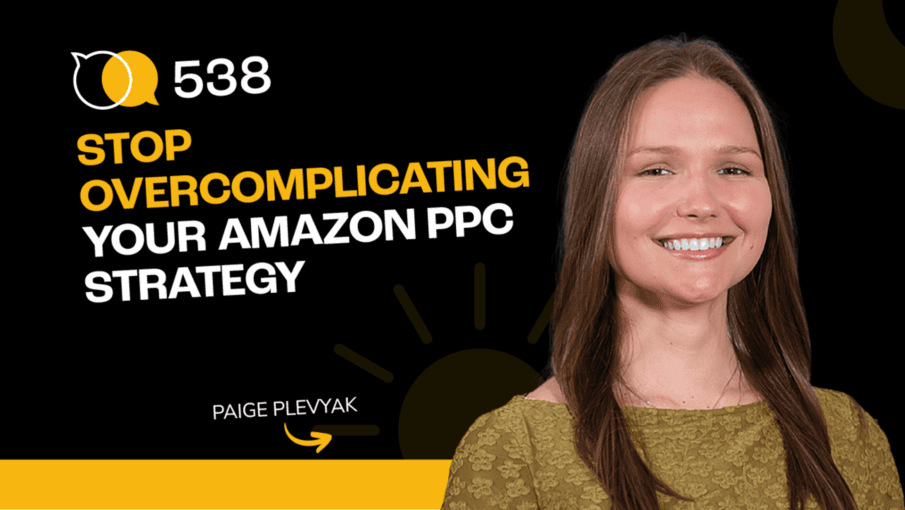
#538 – Fix These Amazon PPC Mistakes Before Q4
Audio version above. Video version below
Amazon PPC can quickly become overwhelming. Sellers are constantly choosing between more keywords, more products, higher bids, new ad formats, and increasingly complex targeting options. But according to Paige Plevyak, Senior Retail Media Manager at Pacvue, better advertising does not begin with more tactics. It begins with a stronger foundation.
In this episode of the AM/PM Podcast, host Carrie Miller and Paige break down some of the biggest advertising mistakes sellers make, including spreading budgets across too many keywords and ASINs, adjusting bids too frequently, and launching campaigns without a clearly defined goal. Paige explains why sellers with limited budgets should often concentrate on five to ten priority keywords, focus spending on hero products, and use long-tail search terms to build momentum in competitive categories.
The conversation also explores when sellers should use Sponsored Products versus Sponsored Brands video, how Amazon Marketing Cloud audiences can improve targeting, and which newer Amazon advertising features may be worth testing. Paige also shares practical advice for recovering after a long stockout, increasing keyword impression share, managing product variations, and deciding when to prioritize immediate profitability over broader visibility.
The biggest takeaway is that strong PPC performance rarely comes from constantly chasing the newest feature. It comes from understanding your goals, focusing your resources, and giving your campaigns enough time and data to work. Build the right foundation first, and every optimization you make afterward becomes more intentional, measurable, and scalable.
In episode 538 of the Serious Sellers Podcast, Carrie and Paige discuss:
- 00:00 – Introduction
- 01:26 – Paige Plevyak’s Retail Media Background
- 03:02 – The Biggest Amazon PPC Mistakes
- 04:10 – Choosing Keywords Without Overspending
- 07:53 – Where Sellers With Limited Budgets Should Focus
- 09:10 – Prioritizing Hero Products and Variations
- 12:01 – Sponsored Products vs. Sponsored Brands Video
- 15:39 – Amazon Advertising Features Worth Testing
- 18:10 – Using AMC Audiences and Bid Boosts
- 19:38 – Preparing Your PPC Strategy for Q4
- 27:15 – How Often Sellers Should Adjust Bids
- 34:13 – Rebuilding Sales After a Long Stockout
Transcript
Carrie Miller:
In this episode, we have Paige Plevyak who is a Senior Retail Media Manager at Pacvue, and she answers tons of questions like how sellers should focus their funds if they have a limited budget, what are the biggest PPC mistakes sellers are making right now, and what Amazon ad features are worth paying attention to. We talk about all of this and more on this week’s episode.
Carrie Miller:
Hello, everybody, and welcome to the AM/PM Podcast. My name is Carrie Miller, and I’ll be your host. This is the show where we discuss all things Amazon, TikTok shop, and Walmart private label, and how to generate recurring revenue streams 24 hours a day during the AM and the PM, hence the name of the show. Get it? AM/PM Podcast. As a matter of fact, this last weekend, I went to a street fair here in town, and even though I was at the street fair just eating lots of food and having a great time, I was still making money online. How cool is that? Pretty cool, I think.
Carrie Miller:
Hello, everyone, and welcome to another TACoS Tuesday. We have a really great topic today, so I’m very excited. We have a special guest, and she is from our sister company, which is Pacvue. A lot of you might not know this, but we have Helium 10 and Pacvue. We’re sister companies. I’m going to bring Paige on. Hello, Paige. Welcome to TACos Tuesday.
Paige:
Hi, everyone.
Carrie Miller:
Can you tell a little bit about yourself and your background and what you do at Pacvue?
Paige:
Yeah. I’m a Senior Retail Media Manager here at Pacvue. I’m specifically our managed service team. Brands can use the Pacvue tool to run their media strategies on Amazon. I specifically work with clients to run their media using our Pacvue tool. A bunch of different packages there, but very involved in the actual client management using the Pacvue tool. Been in the industry for a little over five years, I think, so got a lot of experience, worked across a lot of different brands, a lot of different product categories, so I’m excited to bring all that knowledge over the last couple of years to today’s questions.
Carrie Miller:
Very nice. Yeah, we’re very, very excited. One question I think people have a lot is the difference between Pacvue and Helium 10 when it comes to managing ads. Can you tell us what kind of clients should maybe look into Pacvue versus Helium 10?
Paige:
Pacvue, I would say, is for brands with perhaps maybe more complicated strategies, not necessarily always, but larger budgets. You have a lot of campaigns you’re managing. Maybe you’re a brand with different product categories and you really need a great organization for setting up your campaigns. You want automation involved using the Pacvue tool to help make your day-to-day management just a lot easier. We have some fantastic features that just make managing your campaigns a lot more seamless than maybe when you’re doing it more manually through other forms. I would say, brands with maybe kind of a lot of undertaking further strategy.
Carrie Miller:
I would like to just get into some questions. The first question that I have for you, Paige, is what are the biggest PPC mistakes that sellers are making right now on Amazon?
Paige:
I think right now something that a lot of people are struggling with is really not having clear goals set for your brand. When you don’t have clear goals of what you’re trying to achieve, you don’t have a strong foundation to your search strategy. And when your foundation is off, you’re going to have a leak in the boat. You’re not necessarily moving towards your goals. So a weak foundation can look like misallocation of your funds across targeting types. Maybe you’re spreading your budget way too thin.
Paige:
Maybe you’re trying to support a lot of ASINs and maybe you need to whittle that list down as a really focus on your top sellers. Maybe you have a ton of keywords in your campaigns and you’re not necessarily being efficient and growing on the right keywords that you should. So it’s really about rethinking what your strategy and goals are and making sure that your campaigns, your management aligns to that. I’m keeping that very broad because I do think a lot of our next questions will help solve this. But it’s just really making sure that you are truly aligned on what your goals are, making sure your campaigns are in line with that.
Carrie Miller:
All right. Sounds good. Jeff said, I’m struggling getting the correct keywords and then overspending. Do you have any advice for Jeff?
Paige:
Yeah. Keywords are always tough, right? Because there feels like there’s a limited amount of keywords out there. And I would say there’s kind of two different ways you can look at keywords. So one, you can have a pretty limited list of keywords in your campaign for your item. Maybe that’s only five keywords. And on those keywords, you’re really focused on getting visibility, clicks, and therefore sales. What’s great about having a more limited list of keywords is it helps that flywheel effect kind of come into motion. When you place an ad on a couple of keywords for your product, over time, the hope is that your product is going to get more sales, get more relevant, and Amazon is going to award you with a higher organic rank on those keywords, right?
Paige:
And that helps that flywheel come into effect because the greater your organic rank is, now you’re no longer paying for those search and grid placements for obviously your organic placements. So there’s more opportunities to capture sales there. And having a tighter list of keywords is going to help, again, really focus your efforts on building organic rank on just a couple of really key priority terms for you. Now, there’s other instances where maybe a lot these top terms, like head terms, are very, very expensive just because other brands in the space. Maybe that’s where if you have a very limited budget right now, you want to focus on more long-tail keywords. For example, let’s say you’re selling water bottles.
Paige:
The term water bottle on Amazon, I’m sure, is highly competitive, probably has pretty high CPCs, and you’re up against some major brands there. So if you maybe get those keywords, a wider list of keywords that are more along the lines of water bottle with straw pink, you’re including a couple of those key defining terms there. You’re going to get consumers who are more sure of what they’re looking for, they’re not so much in the discovery phase because they already know what they’re looking for in terms of water bottles, and therefore maybe a little bit more efficient to you, and probably because they’re longer tail, have less of those major competitors on there raising up those CPCs. So I think in those instances, you can have a lengthier list of keywords to try to feel out and capture what’s going to work for your brand.
Carrie Miller:
Yeah, I think that’s really good advice to just look for some of those longer tail keywords because they do include water bottles, so you’ll still rank somewhat for water bottle. So that’s kind of a good strategy, especially if you have a limited budget because I know there’s a lot of big brands that maybe they’re selling water bottles and they can come in and spend 20 bucks a click. But for the smaller sellers, yeah, it’s a really good idea to just look at those lower hanging fruit keywords. But then obviously, like you said, the top maybe five keywords or so that you really want to rank for, focus on those, even if they’re kind of expensive.
Paige:
And I will say something, there is some benefit. Let’s just say, again, you’re bidding on the term water bottle and maybe from an efficiency standpoint, it’s not great. Your ROAs might be a little bit lower, your CPCs are higher. Just think a person may search water bottle, see your brand, but not necessarily click into the ad. And then when they go and search for pink water bottle, they kind of have that, they might be more likely to click on your brand because they’ve seen your product before. And there’s a bit of that consumer bias to kind of liking to purchase things that we’ve seen multiple times.
Paige:
So that is one value to getting on some of those more trafficked, highly competitive terms is just that repetition of getting in front of the consumer. You might not be getting the credit for showing on that term. You’re getting the credit for another keyword, but it kind of goes all into that, again, that flywheel effect again. And it might be a little bit complicated, but still something to think about. You can’t always be just using ROAs and CPC as your baseline, because there are some things here that we can’t take. We aren’t getting data to back up that it’s working.
Carrie Miller:
Yeah, very good. All right. The next question, if sellers have limited budgets, where should they focus first?
Paige:
Yeah. Again, this goes back to your foundation here. And I feel like there’s three different things of your foundation. One is keywords, which we just touched on, making sure that your keyword list is appropriate for your brand and your budget. I think oftentimes we want to put every single keyword possible into our campaign. Likely having a list within five to 10 keywords is probably the best place to start here. So if you have a crazy keyword list, you might be spending your budget inefficiently and just spreading yourself way too thin.
Carrie Miller:
Yeah.
Paige:
The next thing you want to think about is ASIN support. Maybe you only have a handful of SKUs in your catalog that you’re promoting. That’s totally fine. Focus on those. But oftentimes there are sellers that have 20 products that they’re trying to push. And unfortunately, you might not be able to be able to support 20 products when your top five products are driving 85% of your revenue. Yeah. That’s an instance where you definitely want to make sure, okay, let’s reallocate our budget away from these. We want to sell it through the inventory, but if they’re not driving boarded revenue, you need to refocus that budget onto the places that might be those top five SKUs.
Carrie Miller:
I was just going to say, is that something you guys advise the bigger brands to do as well? When you see those things happening, you’re just like, let’s reallocate the budgets to the top five or the top winners. Okay.
Paige:
100%. Again, that comes into that setting your goals for your brand. If your goal is driving sales, you’re very likely just want to put your budget behind your top SKUs. Now, if you have innovation items and you’ve maybe launched into new product categories for your brand, maybe your goal is again, driving that new product category. And that’s an instance where, hey, maybe it’s not yet a top selling item, but we still need to put money there and push a good amount of our budget there. And that just, again, comes to setting your goals. Is it pushing new innovation? Is it pushing just total sales for your brand? Something else that I think really comes into play with helping with SKU management is variations.
Paige:
Variation strategy is super, super important. I’m just going to give an example here. If you are a protein powder brand and you have 10 different flavors, you probably want to support all 10 different flavors, but that’s probably not the direction you should be moving. Probably should only support one or the top two items. And by having variations, you’re still going to be able to get a lot of great visibility for those other flavors that you have while putting a majority of your budget behind your most efficient SKU, your top selling SKU. And I always urge people to think of consumer behavior. Think of your own consumer behavior on site. The amount of times that you’ve clicked on something like protein powder, you just click on the vanilla option because it’s the first one you see of that brand. And when you’re on the PDP, you see the peanut butter flavor.
Paige:
You’re like, oh, actually, that looks pretty good. I’m going to get the peanut butter. So you don’t need to support the peanut butter SKU or any other of these random flavors just to get sales moving behind them. If they are varied with your top product, consumers are going to discover that product regardless. So that is definitely a key tip that I have is figure out a variation strategy that works.
Carrie Miller:
So are you saying just pick your hero within the variation and just advertise on that? Like say it’s say it is like vanilla protein, you’re advertising on all the vanilla protein keywords as well as just the regular protein powder keywords. You’re doing all that with just that one SKU or would you say, hey, if we also have chocolate, we’re going to do some chocolate keywords and then some, you know, maybe some matcha keywords for our matcha flavor. Like, yeah, are you just match us out? Good. I went that way. Yeah.
Paige:
Again, it really depends on your budget and what you can afford support. I there’s definitely an instance. I feel like chocolate vanilla in this instance are the two most popular flavors. So it definitely makes sense to also support the chocolate there. That’s a great instance. But again, there’s probably not that much appetite for coffee flavored protein powder. And if you were to use helium 10 to look at the search velocity of these terms, you would figure that out. So, again, it’s a great let’s just let the consumers figure out that we have coffee. We don’t necessarily need to support that search ads.
Carrie Miller:
All right. When should sellers use sponsored products versus sponsored brand videos?
Paige:
Yeah, this is a great question. So what I’ll say generally, what I’ve observed over the years of managing several brands, you’re typically going to put a large majority of your budget into sponsor product, oftentimes 70, 80 percent of your budget. This is where you are getting the best consumer engagement. You’re getting your most impressions, clicks, sales, CPCs tend to be lowest here. And again, think of your own consumer behavior on Amazon. You’re probably nine times out ten clicking the sponsor product placement. So that’s where you’re going to reach those customers. However, there are definitely instances when sponsored brand video might make more sense. And I’ll explain with a little example here.
Paige:
So think of a product that is a super easy purchase for consumers. There’s not a lot of thought behind it. It’s a very self-explanatory product, for example, hand soap. If someone’s searching for hand soap on Amazon through just the description of the products that appear and the little image that appears in search and placement, consumers can see that it’s lemon scented, that it has that it’s a two pack and that it’s a pump. Right. We don’t need a sponsor brand video to explain that to the consumer. Your main priority is just appearing at the top of search because on a term like that, consumers are just looking for something that fits their price range and kind of maybe the scent that they want. They’re not doing a lot of scrolling and they’re not doing a lot of discovery.
Paige:
Now, there’s also more. It’s the word I’m looking for. More complicated products in very crowded categories. I think a great example of this is a vacuum. Right. So vacuum users vacuum on Amazon. There are hundreds, if not thousands of products that show up. Obviously, some of those are going to be the premium high price brands that, you know, is offered. We’re going to neglect that for the sake of this demonstration and just say, you know, consumers are looking in that 70 to 140 dollar range kind of a mid-range vacuum. They know it’s going to be decent, but they don’t want to spend a large chunk of money on it. There are a ton of vacuums on site that fit that description of kind of that mid-range vacuum. You just want it to work. It’s very hard for consumers to decide what they actually want to purchase. And so sponsor brand video is fantastic to stand out in this category, especially for a complicated product of vacuum. People just want to know it checks the boxes. Right.
Paige:
So if you have a 20 second sponsor brand video that quickly explains to consumers that it is cordless, it is a three hour battery life. It sucks up pet hair and is a floor vacuum and a hand vacuum all in one. You can, you know, assemble it likewise or as you need to. That’s a great selling point for consumers. Consumers are going to see that, you know, top of search and say, oh, easy peasy. Add that to cart. Maybe they look at the PDP just to double check and then they add it to their cart and purchase it. So, again, there are definitely instances in these very crowded, complex categories where sponsor brand video is definitely the way to go. You still want to have some sponsor product presence as well. Being able to explain those really kind of different features of your product is going to be a lot easier for the consumer to add that product to your cart.
Carrie Miller:
Yeah. I like that you were saying how to get directly to the point, because some people try to go kind of artsy with their videos and it’s like you really just have to tell them exactly what the product is super fast.
Paige:
Especially products like coffee makers or vacuums like we just want to know. Now, I understand with, you know, maybe skincare brands, that kind of stuff that does have a more aesthetically driven aspect to it. Then, yeah, maybe you do need to have more of those types of shots in there. But for complicated products like that, you just want to show the features in as little time as possible that makes sense for your video.
Carrie Miller:
Yeah. Very good. Okay. Which new Amazon features are actually worth paying attention to? Because I know a lot of things come out. People get confused and overwhelmed. Yeah. What’s worth paying attention to?
Paige:
Yeah. And I do want to know, again, there’s a ton of new features that Amazon’s coming out with over the years. There’s just been a bunch. And I need to make sure your foundation is set before you expand into a lot of these tactics. I think, you know, AMC bid, you know, sponsored product bid boost is one of them or like make sure your foundation is set before you go into that. But one that I think is super easy for brands to hop on board with is sponsor product video. That was a newer release from Amazon within maybe the last six months to a year. And it’s very easy to do this. You can go into your pre-existing sponsor product campaign.
Paige:
You click on the SKU and then there’s a section to add that video in and you just upload your video. And, you know, it almost looks like a sponsor brand video when it appears on site, but actually you’ll notice that has like, I think you can put up to five videos and it allows the consumer to click on each of these videos. And they’re usually only like five to 10 seconds and you can name them with your features. So again, in the vacuum case, we can, we can name one cordless and it shows how, you know, in 10 seconds, how this is a cordless vacuum, how you charge it and how much battery life it has. And then the next feature and the next feature. So it’s again, very similar sponsor brand where there’s definitely some use cases where this will be super, super beneficial.
Paige:
What’s great about it is you don’t have to create entirely separate campaign. It’s built into your sponsor product campaign and Amazon’s algorithm, to my understanding, kind of decides when to put the video out versus a regular search and grid placement. So you’re not going to completely go overboard only investing in this. And what I’ve seen, the little bit of testing that I’ve done and what I’ve heard from colleagues is that it tends to be pretty efficient and is a very low lip for your campaign. So definitely think that’s a great area for people to test out. I think something else that is a good feature is Amazon’s AI creative studio.
Paige:
Personally, I had not done testing with that. However, I think it’s a great option for brands that are sellers that do not have obviously the ability to have their own creative made. They can’t do it themselves. They don’t have an in-house creative team. A lot of the larger brands are slow to adopt this, rightfully so. They have their own creative teams that know exactly what kind of branding they need in their videos. But if you just want to start getting a sponsor product video running or sponsor brand video running, try the AI creative studio. It’s going to be a really great way to try getting some assets up and running. They’re going to look like their AI a little bit depending on what you type in. But I think that’s a great opportunity to just begin testing that as well.
Carrie Miller:
What about audiences? Have you seen some good results with audiences with the brands that you’ve been managing?
Paige:
You mean the AMC audiences?
Carrie Miller:
Yeah.
Paige:
So the AMC audiences are, they’re a tough one. Because what I’ll say is if you again don’t have a super refined keyword list, you might be bid boosting on keywords that are just completely increasing your CPCs, right? So you have to be careful with that. I think there’s more opportunity there for you to kind of make a mistake and then increase your CPCs and bring your efficiency down. But let me explain like why AMC audiences can be great. So it just basically what AMC audience does for anyone who’s not aware is it just helps qualify your audiences a little bit more when you’re targeting them in search. So for example, you could take an audience, let’s say it’s Prime Day, right? And you know a lot of people are on site and they’re kind of scoping out what brands they might want to buy, what’s available. What you can do is then during Prime Day, put on this bid boost that says, hey, let’s increase my bid and make me more likely to serve my ad on anyone who clicked on my PDP within the last seven days.
Paige:
So that means consumers who were clearly interested in clicking around before Prime Day scoping out deals are now going to see your sponsored search ad appear above other brands and hey, it has a $5 coupon on it now and they purchase it. So it just qualifies your audiences a little bit more. And in some cases may make your ads a lot more efficient and increase that conversion right there. And there’s a ton of audiences. That’s just one example of them.
Carrie Miller:
Yeah, definitely. Okay, let’s go into the next one. If a seller could improve only one thing before Q4, what should it be?
Paige:
Yeah, again, I really think it’s just to reiterate, it’s making sure your sales goals are aligned to Q4. Q4 is a very exciting time period on Amazon. There’s a ton of traffic, there’s a ton of buzz, people are buying for Christmas and holidays. And so consumers are on site and they’re shopping and they’re discovering, but you need to make sure that your strategy is aligned. For example, if you have a ton of inventory left on certain products, it may be wise to make sure that you are prioritizing those high inventory products in your sponsored search campaigns. If your goal is just to make sure you meet your sales goal for the year, make sure you’re prioritizing the top selling products with your budget. Maybe you’re focusing on new to brand, look at some of your new to brand metrics, focus on those brands and so forth. So narrow those down and go into Q4 with the right strategy so you can kind of finish out the year on a good foot.
Carrie Miller:
All right. I have one last question here before I get into the audience questions and that is, when should sellers prioritize immediate sales versus increasing visibility and brand awareness?
Paige:
Yeah, it’s always going to be a tough one because when you start to increase visibility and try to get out there, you’re going to be a little shocked and say, oh no, my ROAS isn’t as good as it was before. Oh, my CPCs are a little bit higher. But that really is pivotal to growing your brand on site. So I would make sure that you’re covered off in the areas that you are. If you feel comfortable with your branded coverage, some brands may not need branded coverage, but let’s say your branded keywords are getting crushed by brands conquesting you, you need to make sure you’re funding that before you’re investing in growing techniques because you may be losing sales in your own branded terms. In the non-branded space, again, I would make sure that you feel comfortable about your current keyword list, you’re growing sales there.
Paige:
Sometimes I think a good example of this is, like we talked about earlier, if you are investing on somebody’s longer tail keywords like pink water bottle with straw, you might have strong return on it, but your ability to scale is probably a little challenging because that’s not as highly trafficked of a term. So if you have kind of maxed out your ability to scale on these lower, you know, long tail keywords, now it’s time to start investing in water bottle and aluminum water bottle and kind of growing in that way. So just make sure your bases are covered. And if you feel the need to scale, you have more budget and you can’t quite spend it in your current tactics. Now let’s scale and get a little bit more creative.
Carrie Miller:
Okay, very good. I’ve heard when assigning manual products or keywords to keep the targets under 10, is this because more than that limits budget spread and you can’t get a good read of what terms work best? If so, should I increase my daily budget? So I’m thinking like 10 keywords in a campaign, I’m assuming.
Paige:
Yeah. Honestly, one thing that why I often say that is because when you have 10 keywords in a campaign, you’ll likely notice that only the top like three or four keywords are actually getting significant spend and all the other ones are getting only a couple of dollars or cents. And that is because Amazon’s algorithm is prioritizing those keywords within your campaign. It’s saying these keywords are driving the most sales. We’re able to scale the most on them and spend on it. We’re going to keep spending on these keywords. We’re not going to spend on the rest of them. So that’s why you can’t have a 50 keyword list because you are just simply not going to spend on those keywords. So that’s, you know, really why I would say under 10, again, if you really want to refine it, maybe five to make sure you’re getting on those other keywords. And then you can have a separate campaign, those other five keywords to make sure you’re getting some coverage there.
Carrie Miller:
All right. And the next one, do we put branded brand keywords in negative keywords if it’s costing us? Now the question is, is this other people’s brands or our own brands?Maybe you can answer for both. Yeah, that’s actually a great question.
Paige:
I guess I’ll answer for both. If competitor keyword branding keywords are entering your campaign and performance isn’t strong and that’s not your priority, negatively target those. In terms of your own branded keywords, definitely. I think the worst offender of this is auto campaigns. Auto campaigns work with Amazon’s algorithms, say, oh, this product is relevant here, here, and here on site. And oftentimes when you take a peek behind the curtain, you’ll notice 75% of your budget is actually just going towards branded keywords. And if you were trying to not overinvest in branded and promote discovery and expanding of your brand, you’re going to want to negatively target those branded terms in your auto campaign to ensure you’re getting coverage across more incremental placements on site.
Carrie Miller:
Awesome. Okay. Next one. How does Amazon stack bid modifiers when you have multiple strategies in place? Example, placement modifier and AMC audience modifier and a dynamic bid strategy.
Paige:
I actually, I don’t know the exact formula for this, but let me think.
Carrie Miller:
Does it get out of control with all those?
Paige:
It does. Yeah, it does. Yeah. They do stack. So you have to be careful that I don’t know the exact way they stack it, but that’s definitely something to keep in mind. If you’re putting AMC audiences on your campaigns, you might want to reduce your placement modifiers because you might be completely overbidding what you think you are now. So again, I don’t know the exact way they stack. I can’t remember, but they do stack and they can add up.
Carrie Miller:
All right. Next question. I have a couple of campaigns that Amazon won’t give impressions to no matter what the keywords are relevant. I’ve tried bids from under the suggested bid to $1 over the suggested bids. They still sit stagnant. Is there any way to overcome this? It seems like Amazon sometimes chooses which campaigns to be to fire regardless of bid.
Paige:
Yeah, I’m having this current issue right now with a sponsor brand video ad of my own. I cannot get impressions behind it. And I don’t know why I keep increasing the bids. It seems like they’re relevant, x, y, z. And I’ve had this happen many times over the years. I think part of it might be a relevancy issue. Now, Amazon doesn’t have super, super strict relevancy hurdles. And I don’t know your instance, but if you’re trying to place a TV on the term toilet paper, you’re probably not going to be able to serve air, but you should be able to get a TV on the term TV remote. So in that instance, I’m not quite sure why that is. You might just be getting completely outbid by other competitors, like your bids at $1 and you have no clue that the bids actually are at $7. So that could be an instance there. You could also always support a ticket with Amazon within the AMS UI. And there’s a feature that says, my ad isn’t giving impressions. And then they can help diagnose the issue for you.
Carrie Miller:
Yeah. We do have a tool in Helium 10 also called Index Checker. And sometimes you might think that you’re indexed for a keyword or a phrase, and you’re not actually indexed for it. So if you go to Index Checker, just put the ASIN and the keywords in there that you’re advertising and see if you’re even indexed for it. Because that sometimes happens. And so Amazon doesn’t look at you as very relevant on that. But it could be something more complicated. So that’s just step one to see.
Paige:
But also just make sure maybe your product isn’t eligible. You probably would be able to see that if you’re the AMS UI. But if your product isn’t eligible to serve with sponsored product because Amazon doesn’t deem its price profitable, you might not be able to serve at all. So definitely look at eligibility.
Carrie Miller:
All right. Let’s go into the next question. What is the best approach to adjust bids when you have hundreds of targets? Because doing it manually takes too much time. How often do you usually do it daily, weekly, monthly?
Paige:
This is a great plug for Pacvue.
Carrie Miller:
And Helium 10.
Paige:
You know, you can adjust your bids in the blink of an eye in these platforms, which is really, really fantastic and just makes it super seamless. I do believe maybe within the Amazon UI there are bulk templates that you could do this with. I don’t have experience with that, quite honestly. But yeah, Pacvue Helium 10 allows you to make that a lot easier. In terms of adjusting, like when to adjust your bids, I would advise against doing it daily because at that point you might adjust your bid, you know, 30 cents and be like, oh, no, like performance went down. But you have one day of data. Right. So I would give it a couple of days to make sure, you know, if you adjust your bid and increase it and within five days you’re seeing a nice increase in spend and your ROAS is actually going up and it might work for you. Then maybe you go in and tweak it a little bit more. So I would definitely do it not daily, not monthly. I think once or twice a week is a good way to go. You don’t want to be making too many bids. It makes it hard for you to actually figure out what’s working, what’s not when you’re constantly adjusting things. Yeah.
Carrie Miller:
And the cool thing with Helium 10 is you can make bid rules and think Pacvue as well. You make bid rules and so it’ll give you suggested bid changes. And so you can just look at those maybe once a week and do it in, you know, 15, 30 minutes. It takes very, very little time depending on how detailed you want to look at it. But that’s really the way to do it because it does get completely overwhelming if you’re doing it manually one by one. That’s just hours and hours of work that you can save by doing bid rules and based on what your goals are. And then you’ll get suggested bids and then you can implement those with just a click. So yeah, I would recommend looking into a software if you have a lot going on.
Carrie Miller:
This next one is if you’re getting a good, getting good conversions for a long tail keyword, does your organic rank improve for all the words in the search term? And generally how long does it take to get ranked use from it? This is kind of a strategy that I have that because I’m in a competitive category as well as I use the longer tail keywords and you will rank for those others. Now I’m not saying you’re going to go way to the top, but what it does is it gets you closer to like page one on some of those keywords that are competitive. And then once you get closer, then you can put more money behind PPC, like targeting those exact keyword phrases. So for example, if it was like a water bottle, but you know, that’s really an expensive keyword. You say, you know, maybe you’re trying to target also water bottles for kids. Okay. So you’re targeting water bottles for kids and you’re getting a lot of conversions on that. And then as you’re doing that, the water bottle gets ranked as well.
Carrie Miller:
Then when you see that go to like page two, then you can start putting some PPC behind water bottle. Cause you’re closer to the top. It’s not going to be as expensive to go from like page six or like wherever lost in the oblivion, wherever products go on certain keyword terms. Then you can start, you know, pushing to rank for that keyword. So it is kind of a strategy if you have a more limited budget, whereas, you know, a lot of brands will just go all out and just cover everything. If you’re, if you do have a lower budget, do the long tail keywords, see where your ranking is going for those main keywords. And then as that goes up, then you can decide when you want to start pushing for that rank as well. For trend driven collaborations and new launches, what is the best practice for keyword strategy, leveraging the partner’s brand awareness through branded search terms or using broader category keywords?
Paige:
I do think using the partner’s brand awareness is, is a great way to get great visibility. Using broader keywords, obviously, again, that gets another way to reach new, new customers on site and kind of get that out there. It just might not be as efficient or effective of a tactic. If you get a protein powder brand, you’re doing a collab with someone else, you’re still in highly competitive category terms. So getting that visibility. But if you want to reach, you know, true fans of your partner, the brand that you’re partnering with, going on their branded terms is probably the best way to do that. And again, maybe using other things like sponsor brands or sponsor brand videos to kind of tell more about that partnership and why it’s happening and tell that story to the consumer might make your advertising just a little bit more effective.
Carrie Miller:
When you suggest to put your budget behind the hero products, does that mean you shouldn’t run campaigns for the other variations at all? Or should you have campaigns for all the variations and just put 90% of the budget behind the hero products and 10% budget behind the other variations?
Paige:
Again, it really depends on your brand. If you think that putting 100% of your budget towards those hero products and you think you’re going to completely crash your other products in your catalog, then don’t do that. I think it’s good to start over time, increasing budget for your products, decreasing for your non-priority items, and kind of see what that does. And over time, you can keep increasing and decreasing as necessary. I want to avoid you completely removing all budget and then crashing your other products here. I think why I say that is because focus your budget, because that’s where you’re driving sales.
Paige:
That’s probably where you want to focus the most of your budget. For these other non-priority items, this might be a great case for you to throw an auto campaign against them. You could put $25, $50 a day, and they’re still going to get a good amount of visibility on site. And that’s a good way that you can maybe have some coverage on your branded terms and get that category keyword mix in there. So again, it’s really up to you. There’s different ways that you can kind of move that around depending on your goals.
Carrie Miller:
When would focus on top of search be sensible?
Paige:
Yeah, I think, again, think of your category, right? So if you’re, back to the handsoap example, people are probably, it’s not a very, there’s clicky and scrolly categories. For example, handsoap is more of a clicky category. The person is likely not scrolling too far down the page. They see what they want. It’s within their price range, within the first five or six placements. Maybe they’ll even make it to the middle of the page and they click and convert. That is an instance where you absolutely want to be top of search because that’s how you’re getting the most visibility. However, there are other product categories like women’s clothing, for example, that are extremely scrolly, right?
Paige:
So people are just scrolling and scrolling. They might go through five pages to find the shirt that they want or the pair of sneakers that they want. So that’s an instance where top search might not necessarily be super necessary. You can settle with the middle of the fold, bottom of the fold placements, excuse me, middle of search, bottom of search placement, and still get a lot of clicks and a lot of conversions that work within your budget and is more efficient than a top of search placement. So think about your category and how consumers are shopping in it.
Carrie Miller:
All right. Very good. Okay. This next one is a long one. What strategy would you recommend after being out of stock for over 55 days? Before the stock out, the product was generating around five sales per day, but after restocking, it appears to have lost its organic rank and sales momentum. Should I focus on aggressive PPC, coupons, lower pricing, keyword ranking, campaigns, or gradual bid increases to rebuild sales history without losing control of the ACOS?
Paige:
Yeah. Genuinely, I think top level could be a mix of all of those. Your goal here is to reestablish relevancy for that item. So all of those things are going to help. If you, again, are focusing more on PPC, you’re going to get your product more visible to the consumers. They’re going to purchase that, increase your sales. Again, that flywheel goes into effect again. But also coupons, lowering your pricing also might make consumers more likely to buy your product, increasing your sales, increasing your relevancy, and so forth. So I think do what makes sense to your brand. If doing coupons and lowering your pricing is going to make your product unprofitable for you, don’t focus there at first. Focus on PPC. Focus on making sure your campaigns are set up as they show with the proper keywords and so forth, rebuilding bids like you said.
Carrie Miller:
All right, very good. This one is from Mark. He says, what lookback period do you usually use to optimize? Is it dependent on velocity of the niche and keywords? What’s the minimum amount of clicks or orders to make an educated bid decision?
Paige:
I think, so lookback period to optimize, like I said earlier, I think a week maybe, five days. Make sure you have time to really look at the data and see how things go. I don’t know if I understand the velocity on the niche part. Carrie, maybe you do. I don’t understand the second question there.
Carrie Miller:
Maybe because there’s a lot more, certain categories have a lot more action than others. There’s some kind of niche categories where they’re really getting very minimal PPC clicks. And so it does take a lot longer to kind of figure out what’s going on. But then again, if you’re in the really aggressive categories, you’re going to be spending a ton of money and kind of feeling out of control.
Paige:
Again, I still maybe, even if it was a very, you’re getting a lot of clicks and it’s a very competitive category, I still would rate maybe three, four, five days. You don’t want to make an optimization after two days. You need that to settle in. Also keep in mind, attribution is at play, right? So a consumer can add something to your cart and they might not purchase it five days later. So you might not get the attribution for the sale on that keyword until several days later. And by then you might’ve thought, like no one’s purchased our product. This keyword is horrible. Let me take it out of my campaign. So keep that in mind. Attribution is 14 days. I don’t think you need to wait 14 days between everything, but just keep that in mind. And in terms of keywords with minimal action, I guess, again, that’s on you to determine if you think you have enough data. In terms of clicks and orders, I will say, I don’t know if I have the exact answer to this. Yeah.
Paige:
If my keyword only has five clicks, does that mean it’s performing well for me or not? Compared to your other keywords, if all of your keywords are only getting five clicks, that probably means you need to increase your bids quite frankly, or add in more highly traffic terms. But if you have keywords that are getting 50 clicks over the course of two days, and then you have some keywords that are only getting five clicks, then maybe fork out those other keywords and focus on the ones that are getting more clicks. And maybe your bids are the same. Maybe you’re getting the same amount of visibility on site. It’s not highly traffic term, and that’s why you’re not getting clicks.
Carrie Miller:
Stephen asked, is it possible to increase impression share for a specific keyword? For example, if our impression share is only 10% on a highly relevant keyword that every competitor is targeting, what factors actually help us increase our share beyond just raising our bids?
Paige:
Budget. Obviously having increased funds to increase the amount of time you’re liable in that keyword, allowing you to get more aggressive is probably going to increase your share. But something else to think of here, if you’re just looking at total and paid impression share, not just sponsored product, for example, there might be the opportunity to utilize a sponsor brand banner or a sponsor brand video placement on the term. It’s going to allow you to get a little bit more real estate on those keywords. And maybe there’s a chance that sponsor brand video as a slightly cheaper CPC is more efficient for you. And so investing a little bit of your budget there is actually going to help you get more impressions than just sponsored products alone. So do think about the other ad units that are at play that could potentially help you.
Carrie Miller:
Awesome. All right. And before we go, people might want to get in touch with you, maybe on LinkedIn. Is there any place that people could find you if they wanted to contact you?
Paige:
Yeah, my LinkedIn, it’s just my name. So, yeah, feel free to contact me on LinkedIn.
Carrie Miller:
All right. Awesome. And thank you so much for joining us. This was really good. A lot of really good information. So there’s tons and tons of questions. I know that we didn’t get to all of them, but I think that’s all we have time for today. But I want to say thank you to the audience also for asking such great questions and then also for page for, you know, kind of sparking their thought process and, you know, asking those questions and just answering these with the full detail. So appreciate you. And we hope to have you again on here some other time and we’ll see everyone else later. Thank you, everyone.
Paige:
Thanks, guys. Thanks for having me.
Enjoy this episode? Want to be able to ask questions to Leo Sgovio live in a small group with other 7 and 8-figure Amazon sellers? Join the Helium 10 Elite Mastermind and get quarterly workshops, monthly training, and networking calls with Leo at h10.me/elite
Make sure to subscribe to the podcast on iTunes, Spotify, or wherever you listen to our podcast!
💰 Get Helium 10 with a special discount to start or scale your e-commerce business here: https://h10.me/h10
Want to absolutely start crushing it on eCommerce and make more money? Follow these steps for helpful resources to get started:
- Get the Ultimate Resource Guide from Bradley Sutton, Carrie Miller, and Shivali Patel for tools and services that he uses every day to dominate on Amazon!
- New to Selling on Amazon? Freedom Ticket offers the best tips, tricks, and strategies for beginners just starting out! Sign up for Freedom Ticket.
- Trying to Find a New Product? Get the most powerful Amazon product research tool in Black Box, available only at Helium 10! Start researching with Black Box.
- Want to Verify Your Product Idea? Use Xray in our Chrome extension to check how lucrative your next product idea is with over a dozen metrics of data! Download the Helium 10 Chrome Extension.
- The Ultimate Software Tool Suite for Amazon Sellers! Get more Helium 10 tools that can help you optimize your listings and increase sales for a low price! Sign up today!
- Does Amazon Owe YOU Money? Find Out for FREE! If you have been selling for over a year on Amazon, you may be owed money for lost or damaged inventory and not even know it. Get a FREE refund report to see how much you’re owed!
- Check out our other Amazon FBA podcasts including the Serious Sellers Podcast.
- You can also listen to the AM/PM Podcast on YouTube here!
